
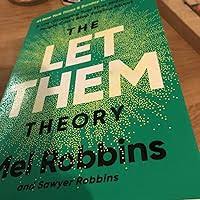
The Seven top tools The Let Them Theory allowed me to adopt.
I finished The Let Them Theory by Mel Robbins (with Sawyer Robbins on the UK edition) and, honestly, I really liked it. (Topping Booksellers) It’s one of those books that gives you a simple phrase you can actually remember mid-stress—mid-argument, mid-injury wobble, mid-race-day chaos.
This year I set myself a health-habit goal: read at least five pages a day. Most days I’ve managed a lot more. That matters, because the biggest win wasn’t “finishing a book”… it was proving (again) that tiny daily behaviours compound. And the book’s core idea sits in the same lane: stop trying to control things you can’t control, reclaim your energy, and put it where it actually changes outcomes.
If you’ve not heard of it: “Let Them” is basically a cue to notice when you’re trying to control someone else’s choices, mood, opinions, or behaviour—and to release that grip. Robbins frames it as a way to stop handing your peace over to other people. (hayhouse.co.uk) But the more balanced (and more useful) version is that it isn’t just “let them”… it’s also “let me”: let me choose my response, my boundaries, my next step. (The Guardian)
I’m going to break the idea down, then translate it into practical tools for runners: training, injury rehab, race day, running clubs, social media, and the classic runner trap—thinking you can control how everyone sees you.

What the book is trying to solve (and why runners are a perfect target audience)
Most runners I see (and if I’m honest… most runners I am) don’t just run. We plan, analyse, adjust, compare, judge, and sometimes try to micro-manage everyone around us:
- “If my partner understood my training, they’d stop interrupting my long run.”
- “If my coach changed the plan, I’d finally stay injury-free.”
- “If my mate stopped running too fast, I wouldn’t get dragged into stupid pacing.”
- “If the weather behaved, I’d nail this block.”
- “If the physio fixes the tissue, everything will click.”
That need to control is understandable. It’s also exhausting.
The Let Them idea is a direct interruption: when someone does something you don’t like (or life does what life does), say “Let them”… and stop wrestling the uncontrollable. Robbins popularised it through her content and podcast, and it’s had a big cultural moment because it’s memorable, shareable, and feels immediately relieving. (Mel Robbins)
But the real value (especially for runners) is what happens next.
“Let Them” isn’t passivity. The magic is in “Let Me.”
One fair criticism of any catchy two-word mantra is that people can use it as emotional avoidance: “Let them” = “I’ll tolerate anything” or “I’ll never have hard conversations.”
That’s not the point. Even media coverage that’s broadly sympathetic to the concept flags this clearly: it’s not a tool for dangerous, abusive, or discriminatory situations, and it still requires boundaries and action. (The Guardian)
This is where “Let Me” matters. In plain language:
- Let Them = stop trying to control what isn’t yours to control.
- Let Me = take responsibility for what is yours: your choices, your standards, your training decisions, your boundaries, your communication.
For runners, this is basically the difference between:
- spiralling about what everyone else is doing, and
- doing the next useful thing.

The best take-home tools (and how I’d apply them as a runner)
Below are the tools I took from the book’s core framework (and the wider “Let Them / Let Me” concept that Robbins teaches in her content). (Mel Robbins) I’m deliberately translating them into running scenarios, because that’s where these ideas either become practical… or they stay as nice quotes.
Tool 1: The “Control Audit” (spot where you’re leaking energy)
Runner version: every time you feel tense, ask: What am I trying to control right now?
Common answers:
- Someone’s opinion of your training
- Your partner’s reaction to your schedule
- A coach’s messaging style
- A running mate’s pace choices
- The timeline of your injury recovery
- Race-day variables (weather, queues, other runners)
Then apply the split:
- Let Them: they can think that / do that / choose that.
- Let Me: here’s what I’m going to do next.
This tool is boringly effective because it turns “stress” into something concrete.
Tool 2: “Let them be them” (and stop making it mean something about you)
Runners are meaning-making machines.
If someone doesn’t “like” your Strava post:
- you decide they’re judging you.
If your club mate runs ahead:
- you decide they don’t respect you.
If your coach doesn’t reply quickly:
- you decide you’re not important.
The Let Them lens is basically: people are allowed to be inconsistent, distracted, imperfect, self-focused, and human.
Let them.
Then Let me decide what I need: clarity, a boundary, a conversation, or simply to drop it.
Tool 3: The “Boundary Script” (simple sentences, no courtroom drama)
A lot of runners don’t lack discipline—they lack simple boundaries.
Try scripts like:
- “I’m not available for extra plans on Sunday mornings. That’s my long run.”
- “I’m keeping my easy runs easy right now. Don’t let me get pulled faster.”
- “I’m rehabbing. I’m happy to socialise, but I’m not racing anyone.”
Let Them have their reaction.
Let Me stick to the standard.
The point isn’t to be rigid. It’s to stop negotiating with yourself every time.
Tool 4: The “Expectation Clean-up” (especially in relationships)
This is where the book lands well for real life: a lot of stress comes from unspoken expectations.
Runner example:
- You expect your family to “get” why the long run matters.
- You expect friends to stop inviting you out late on Fridays.
- You expect a partner to be excited about your marathon build.
Sometimes they will. Sometimes they won’t.
Let them not be a runner.
Let me communicate what I need clearly, and then decide how to organise my week around reality—not fantasy.
Tool 5: The “Social Media Detach” (stop handing your confidence to the algorithm)
This is a big one. The book’s broader promise is to free you from the opinions and judgement of others. (hayhouse.co.uk) For runners, that’s basically a Strava and Instagram detox without deleting your accounts.
Practical version:
- Post your training because it helps you reflect, not because you need validation.
- Don’t refresh for approval.
- Don’t let other people’s highlight reels rewrite your self-belief.
Let them post their 5k PB.
Let me run my plan.
Tool 6: The “Injury Timeline Release” (stop demanding certainty)
Rehab messes with runners because it removes control.
You want a date. You want a guarantee. You want the body to behave like a spreadsheet.
But tissue, pain, sleep, stress, life—none of it is perfectly linear. A balanced use of this framework is:
- Let Them: let your body be a body (variable, adaptive, occasionally annoying).
- Let Me: do what consistently nudges the graph upward: appropriate loading, good sleep, sensible progressions, honest monitoring.
It’s not “accept defeat.” It’s “stop fighting biology and start training it.”
Tool 7: The “Race Day Bubble” (let chaos be chaos, protect your execution)
Race day is basically a live demonstration of what you can’t control:
- weather
- toilets
- transport
- other runners’ pacing
- signage
- unexpected niggles
So the mantra becomes a performance tool:
- Let them queue slowly, surge early, run tangents, panic.
- Let me execute: warm-up, fuelling, pacing, rhythm, and decision-making.
This is the runner’s version of emotional regulation.

What I think the book does really well
It’s memorable enough to use in real time
Most personal development advice fails because it’s too complex to access when you’re triggered. “Let them” is almost aggressively simple, which is exactly why it spreads. (Mel Robbins)
It pulls you back to agency
The broader framing—stop giving your power away to other people—is psychologically useful when you’re stuck in resentment, rumination, or people-pleasing. (hayhouse.co.uk)
It normalises boundaries without turning you into a robot
The better interpretations of this idea explicitly include “Let me” (your actions, your choices) and warn against using it where safety and justice are on the line. (The Guardian)
A balanced critique (because no mantra fixes everything)
1) It’s not new—and that’s okay
A fair critique is that the underlying idea resembles older frameworks: Stoicism (“focus on what you can control”), acceptance-based approaches, and long-standing boundary work. That critique has been made publicly, and it’s valid. (The Guardian)
But “not new” doesn’t mean “not useful.” In running we happily repeat ancient principles—progressive overload, consistency, recovery—because the basics work.
2) It can be misused as emotional avoidance
If someone uses “let them” to avoid necessary conversations (“I’ll just detach”), relationships drift. Even the popular discussion around the concept highlights that it shouldn’t be applied blindly, especially where harm is present. (The Guardian)
For runners: if you “let them” when your coach is repeatedly dismissive, or your training group pressures you into reckless sessions, you’re not finding peace—you’re abandoning your standards.
3) Some problems do require collective action
There’s a tension here: personal peace matters, but some situations improve because people challenge systems, speak up, and advocate. A purely individual “detach and focus on me” approach can be incomplete.
So I’d frame it like this:
- Use “Let Them” for ego friction, social comparison, and control habits.
- Use direct action for safety, fairness, and values.
A simple 7-day runner experiment (to actually use it)
If you want to road-test this without turning it into a personality:
Day 1: Notice one control thought per day. Write it down.
Day 2: Apply “Let them / Let me” to a small irritation (traffic, queue, Strava comparison).
Day 3: Use one boundary script (training time, pacing, recovery).
Day 4: Do one “social media detach” rep: post and don’t check.
Day 5: In rehab/training, replace certainty-seeking with process goals (sleep, session quality, consistency).
Day 6: Have one brave conversation you’ve been avoiding (kind, direct, short).
Day 7: Reflect: where did you feel lighter? where did you need more action?
That’s it. No spiritual overhaul required.
Closing thoughts (runner edition)
The reason I rate The Let Them Theory is not because it’s revolutionary. It’s because it’s usable.
Running is already hard. Training is already a commitment. Injuries already test your patience. The last thing you need is to spend extra energy trying to manage other people’s choices, opinions, and behaviours.
So yes: let them.
But don’t stop there.
Let me keep the easy runs easy.
Let me build capacity gradually.
Let me hold boundaries around sleep and recovery.
Let me train for the runner I am, not the runner I’m trying to impress.
That’s where the peace and the performance gains tend to show up.
Thanks for reading
James
@physiorun
References (Harvard style)
Robbins, M. and Robbins, S. (2024) The Let Them Theory: A Life-Changing Tool That Millions of People Can’t Stop Talking About. Hay House UK Ltd. ISBN: 9781788176187.
Hay House UK (2024) The Let Them Theory (UK edition) – book information page. Available at: https://www.hayhouse.co.uk/the-let-them-theory-uk (Accessed: 7 January 2026).
Robbins, M. (n.d.) The Let Them Theory (official book page). Available at: https://www.melrobbins.com/book/the-let-them-theory/ (Accessed: 7 January 2026).
Robbins, M. (2024) The Mel Robbins Podcast – Episode 70: The Life-Changing “Let Them” Mindset. Available at: https://www.melrobbins.com/episode/episode-70/ (Accessed: 7 January 2026).
Robbins, M. (2024) The Mel Robbins Podcast – Episode 119: 6 Ways to Use the “Let Them” Theory to Improve Any Relationship. Available at: https://www.melrobbins.com/episode/episode-119/ (Accessed: 7 January 2026).
Aggeler, M. (2025) ‘“Let them”: can this viral self-help mantra change your life?’, The Guardian, 29 January. Available at: https://www.theguardian.com/wellness/2025/jan/29/let-them-mel-robbins-self-help-mantra (Accessed: 7 January 2026).
Vox (2025) ‘Is the viral “let them” theory really that simple?’, Vox, 2025. Available at: https://www.vox.com/culture/402666/mel-robbins-let-them-theory-self-help-guru-tik-tok (Accessed: 7 January 2026).
Verywell Mind (2025) ‘How the Let Them Theory Can Transform Your Relationships’. Available at: https://www.verywellmind.com/let-them-theory-8773871 (Accessed: 7 January 2026).
Psychology Today (2025) ‘Embracing Detachment: The “Let Them” Theory’. Available at: https://www.psychologytoday.com/gb/blog/consciously-creating-your-soul-life/202503/embracing-detachment-the-let-them-theory (Accessed: 7 January 2026).
The Washington Post (2025) ‘“The Let Them Theory” started as self-help. Now it’s a whole lifestyle.’ Available at: https://www.washingtonpost.com/books/2025/08/30/let-them-theory-mel-robbins/ (Accessed: 7 January 2026).
Comments are closed