
The 6-Week Capacity Check: four simple tests that keep runners improving (without guessing)

Most runners don’t need more training ideas. They need feedback.
Not “how did that run feel?” (useful, but vague). I mean proper, repeatable numbers that tell you whether your body is actually building the traits that make running feel easier and injuries less likely to gatecrash your plan.
That’s why we run a 5–6-weekly Capacity Check in the PhysioRun Classroom: a small set of tests you can repeat every six weeks to track what actually matters for runners:
- Capacity: can your tissues keep doing the work, under fatigue?
- Symmetry: does one side keep lagging behind?
- Confidence: does your body feel reliable again—today and tomorrow?
If you want to follow the full guided session, it’s on YouTube Below.
And if you like the STRIDE lens, this sits right in the S = Strength and D = Durability domains (with a big nod to Technique and Rhythm, because “quality reps only” is basically a technique audit under fatigue).

What you’ll need (keep it boring and consistent)
- A stable chair (no wheels)
- A wall (fingertip support is fine)
- A timer
- A notepad and pen to record your specific numbers
The whole point is repeatability. Same chair. Same shoes (or barefoot—just keep it consistent). Similar time of day if you can. ( Join us in the classroom to complete live every 5-6 weeks).
How to score it (the rules that make the data meaningful)
Time: 2 minutes per test
Quality reps only: you stop counting when form collapses
Pain ceiling: keep pain ≤ 3/10. Stop if it ramps up, turns sharp, or changes your movement.
That pain rule is deliberately conservative. Many rehab models allow “some pain” during loading as long as symptoms settle and next-day response is acceptable—but for a general runner baseline test, ≤3/10 keeps you honest and safer.
Record right and left separately for the single-leg tests.
Note the after-effect: how does it feel later that day and next morning? That’s part of the result, not an afterthought.
The tests (and what they tell you)
1) Single-leg calf raises (straight knee) — 2 min AMRAP

Why runners should care: Your calf complex is a workhorse for running. If your calf endurance is low (or asymmetric), your system often “pays the bill” somewhere else—Achilles, plantar fascia, shin, knee, hamstring, even hip—depending on your pattern.
How to do it
- Fingertips to the wall for balance only
- Tall reps, controlled down
- Count only clean reps
- Record Right + Left
Normative values (2 minutes, repetitions)
These reference values come from a large normative dataset using a standardised heel-raise protocol.
Dominant leg — repetitions (n) P = Percentile
| Group | P25% | P50 (median)% | P97.5% |
|---|---|---|---|
| Overall | 13 | 25 | 50 |
| Female | 13 | 24 | 43 |
| Male | 14 | 26 | 53 |
Non-dominant leg — repetitions (n)
| Group | P25% | P50 (median)% | P97.5% |
|---|---|---|---|
| Overall | 12 | 24 | 51 |
| Female | 11 | 23 | 48 |
| Male | 13 | 26 | 62 |
How to interpret it (runner-practical)
- If you’re near the median: solid. Now build it and keep it symmetrical.
- If you’re low: don’t panic—use it as a priority signal.
- If one side consistently lags: treat it as a “leak” in your STRIDE Strength/Durability bucket and programme accordingly.
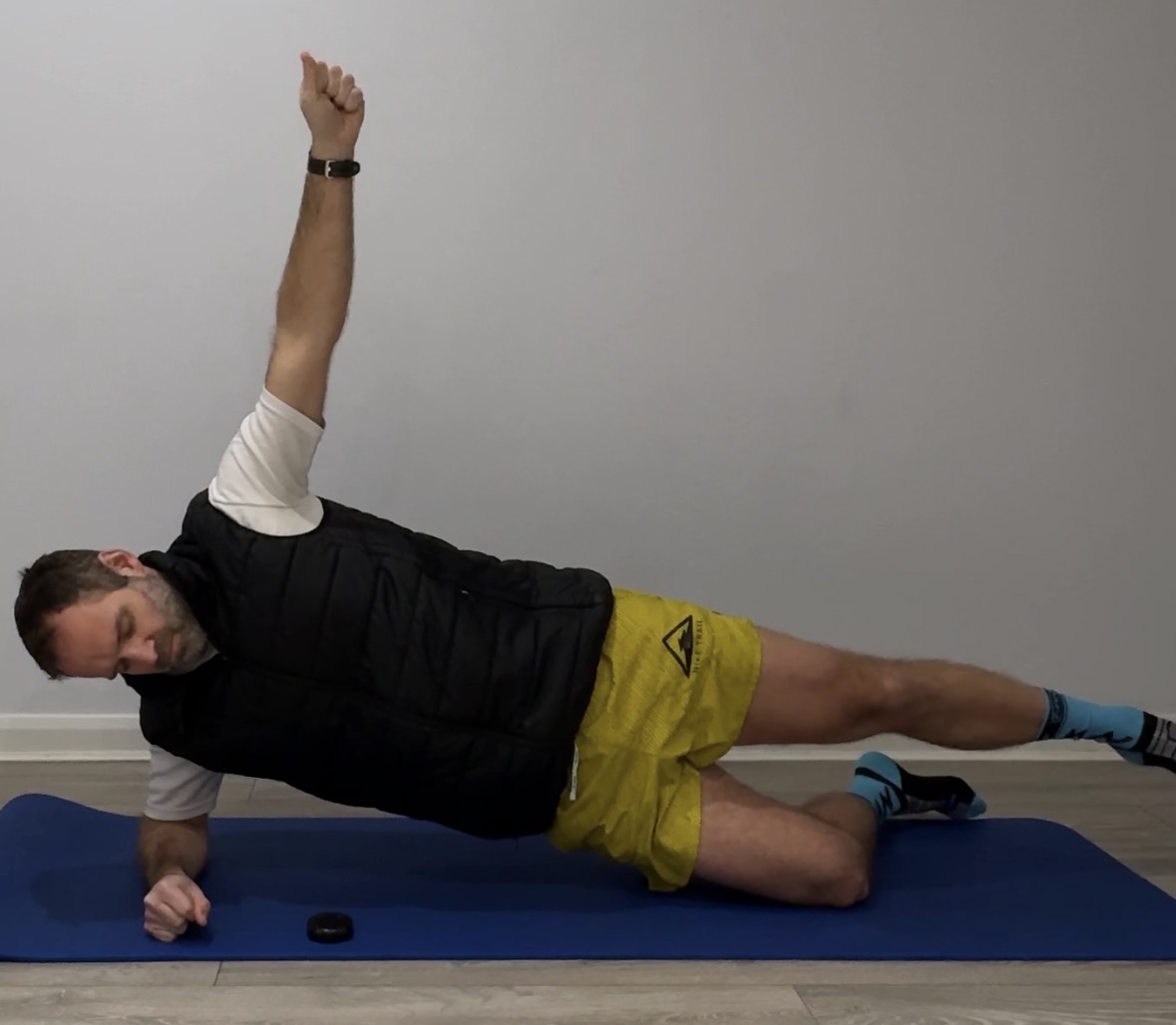
2) Side plank / side bridge — timed hold (up to 2 minutes)

Why it matters: This is not about having “abs”. It’s a quick audit of lateral trunk/hip endurance—useful for runners because fatigue often shows up as pelvic drop, trunk sway, knee collapse, or that vague “I just fall apart late in a run” feeling.
How to do it
- Elbow under shoulder
- Hips stacked
- Lift and hold top leg parallel or above
- No sag, no twist
- Record Right + Left (max 2 minutes)
Normative quartiles (seconds)
These age/sex/side quartiles come from published adult normative data.
| Age band | Sex | Side | P25 (s) | P50 (s) | P75 (s) |
|---|---|---|---|---|---|
| 19–29 | Male | Left | 57.5 | 82.0 | 128.0 |
| 19–29 | Male | Right | 39.5 | 86.0 | 131.25 |
| 19–29 | Female | Left | 28.8 | 58.6 | 84.5 |
| 19–29 | Female | Right | 35.0 | 56.0 | 83.75 |
| 30–39 | Male | Left | 52.5 | 74.0 | 100.5 |
| 30–39 | Male | Right | 57.0 | 70.0 | 105.5 |
| 30–39 | Female | Left | 25.15 | 50.0 | 69.5 |
| 30–39 | Female | Right | 27.0 | 49.0 | 62.5 |
| 40–49 | Male | Left | 38.25 | 70.5 | 102.0 |
| 40–49 | Male | Right | 38.5 | 70.0 | 107.25 |
| 40–49 | Female | Left | 19.0 | 36.0 | 69.5 |
| 40–49 | Female | Right | 10.5 | 38.0 | 67.0 |
| 50+ | Male | Left | 25.75 | 48.0 | 81.5 |
| 50+ | Male | Right | 29.25 | 53.0 | 76.75 |
| 50+ | Female | Left | 13.13 | 18.5 | 58.5 |
| 50+ | Female | Right | 11.48 | 21.5 | 46.5 |
Interpretation tip: if you’re shaking like a leaf at 25 seconds, that’s not “bad”—it’s just a clear training direction.
3) Single-leg sit-to-stand — 2 min AMRAP

Why it matters: This is a brutal (in a good way) blend of quad capacity, hip control, balance, and confidence—especially relevant if you’ve had a knee wobble phase, calf/foot issues that change your mechanics, or you just feel “one side does more work”.
There’s decent evidence that single-leg sit-to-stand style tests are reliable, and they correlate with lower-limb strength/functional status in rehab contexts.
A key limitation: normative reference values for the exact 2-minute version are not well established in the literature (so treat “percentiles” as rough guides, not gospel).
How to do it
- Same chair height every time
- Stand on one leg, controlled touch down
- Record Right + Left
- If you need fingertip assist: fine—just note it
A practical (approximate) way to benchmark
If you want a ballpark comparison to a 30-second style reference, you can normalise:
“Reps per 30 sec” ≈ (2-min reps ÷ 4)
But fatigue over 2 minutes isn’t linear, so use this as a rough compass, not a courtroom verdict.
Estimated percentiles (19–49 yrs), 30-second reference style (reps)
Dominant leg
| Percentile | Reps |
|---|---|
| 5th | 9 |
| 10th | 11 |
| 25th | 14 |
| 50th (median) | 18 |
| 75th | 22 |
| 90th | 25 |
| 95th | 27 |
Non-dominant leg
| Percentile | Reps |
|---|---|
| 5th | 9 |
| 10th | 11 |
| 25th | 14 |
| 50th (median) | 17 |
| 75th | 21 |
| 90th | 24 |
| 95th | 25 |
If you’re using this: treat it as a personal trend tool first, and a “nice to know” benchmark second.
4) Pogo jumps (elastic capacity) — 2 min AMRAP

Why it matters: This is your “spring” check—how well you can express quick stiffness and repeat it under fatigue. For runners, that’s a neat proxy for elastic/reactive qualities.
Plyometric training (done sensibly) is consistently linked to improvements in reactive strength measures in healthy populations.
How to do it
- Small, quick hops
- Quiet landings
- Minimal knee bend (think “stiff but not tense”)
- Record total hops
If hopping doesn’t suit your current injury: swap to fast calf raises for 2 minutes.
Benchmark idea
A simple target many runners use is ~100 reps per minute (so ~200 in 2 minutes). I’d treat that as a training goal, not a published normative standard.
How to use your results (this is where runners actually improve)

1) Trend beats talent
The most valuable question isn’t “am I good?”
It’s: am I improving every 5-6 weeks?
If your numbers are trending up and symptoms are stable, your programme is doing its job.
2) Symmetry is a clue, not a religion
If one side repeatedly lags, you’ve got a programming signal.
A common practical flag is >10% difference, but context matters (history, pain, confidence, dominance). Also, “symmetry” can sometimes mislead—your “good side” can detrain too, making limb symmetry look artificially great.
3) The next-day response is part of the test
If you smash the numbers but your tendon/knee/foot bites you the next morning, that wasn’t a win—it was information.
This is very aligned with pain-monitoring approaches used in tendon rehab: performance matters, but so does symptom behaviour afterwards.
Turning the weakest test into a 6-week STRIDE block
Here’s a simple way to think about it:
- Your weakest test becomes the priority for the next block.
- You keep the others ticking over with minimal dose.
- You re-test in six weeks and see if the “leak” is sealing.
If calf raises are your limiter (STRIDE: Strength + Durability)
Twice weekly, pick one:
- Heavy slow calf raises (straight knee + bent knee)
- Single-leg calf raises with tempo (e.g., 2 seconds up, 3 seconds down)
- Isometric calf holds (mid-range) if tendon-sensitive
Progress by: reps → load → range → speed (in that order).
If side plank is your limiter (STRIDE: Technique + Durability)
Twice weekly:
- Side plank holds → long-lever side plank → star side plank
- Add breathing control (slow nasal breaths) to keep it honest under fatigue
Progress by: time → lever length → movement.
If sit-to-stand is your limiter (STRIDE: Strength + Confidence)
Twice weekly:
- Split squat / rear-foot elevated split squat (range you own)
- Step-ups (slow down phase)
- Single-leg sit-to-stand practice at consistent chair height
Progress by: control → reps → load.
If pogo jumps are your limiter (STRIDE: Rhythm + Intention + Durability)
Two options depending on history:
- If impact-ready: pogos → skipping → bounds (very gradually)
- If impact-sensitive: fast calf raises → ankle stiffness drills → small pogos
Progress by: volume → stiffness quality → complexity.
Important runner reality check: Strength training clearly helps athletes in general reduce injury risk, but runner-specific prevention evidence is mixed and often comes down to compliance and supervision.
So your goal here isn’t “do strength because it magically prevents injury.” It’s: use strength work to build capacity, improve running performance traits, and make your body more robust to training.
Want an extra layer? Pair this with STRIDE
If you like having a bigger framework than “do more calf raises,” pair your scores with a STRIDE check-in (Strength, Technique, Rhythm, Intention, Durability, Enjoyment). The STRIDE tools are housed on the PhysioRun hub.
Quick next step (the simplest action that works)
- Do the session.
- Log your scores (R + L).
- Tell me which test felt most limiting: calf / side plank / sit-to-stand / pogo—and whether the limiter was fatigue, balance, pain, or confidence.
That answer basically writes your next six-week plan.
And if you want a deeper foot-and-ankle strength pathway that plugs directly into your running, “Unlace the Brace” is built for that.
Confidence level: High for the calf raise and side plank reference values; moderate for the sit-to-stand percentile benchmarking (use mainly for self-comparison); moderate for pogo “targets” (use as a training heuristic rather than a normative standard).
Thank you for reading
James @physiorun
Comments are closed