
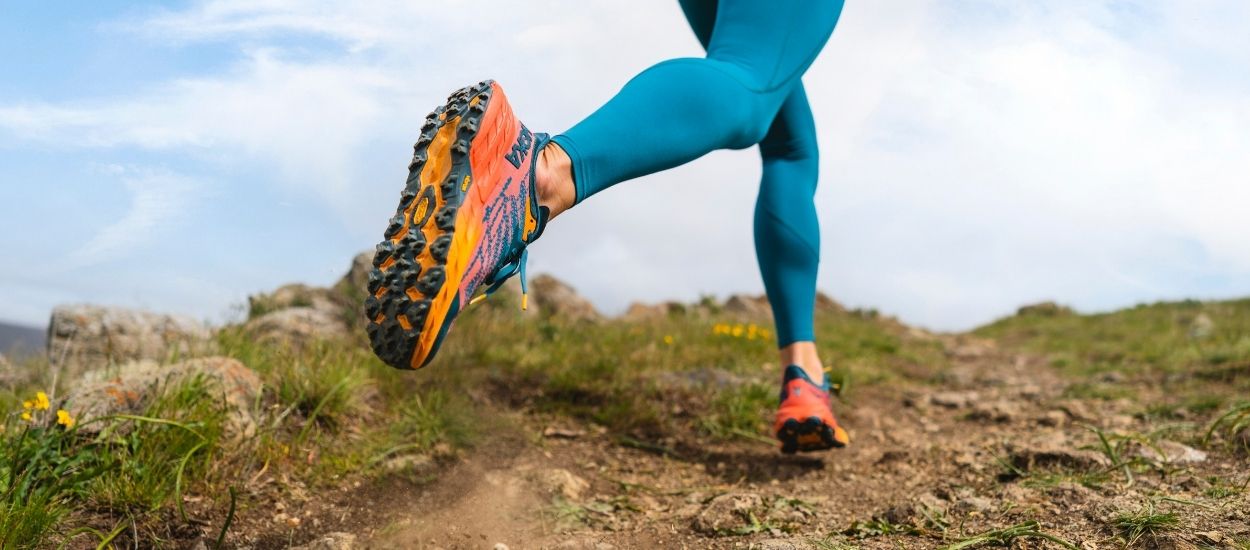
The clocks haven’t gone back yet, but anyone running the trails this month will already recognise the signs — heavier dew, softer ground, and that first properly wet Saturday long run. September is when most of the big trail brands land their GORE-TEX shoes for the season, and this year’s crop is a strong one. Here’s a look at six new arrivals, what’s actually changed under the hood, and who each one suits.
A quick note on the tech first: several of these use GORE-TEX Invisible Fit construction rather than the older bootie-style lining. Instead of a separate waterproof sock stitched inside the shoe, the membrane is bonded directly to the upper. The result is a lighter shoe, faster drying time, and — because there’s no gap between layers — less risk of water getting trapped against the foot once it does get in. Worth knowing before you assume “GORE-TEX” always means the same build.
HOKA Speedgoat 7 GTX — £165
The Speedgoat has been the default recommendation for years, and the GTX version of the 7 is the most technical yet. It keeps the supercritical EVA midsole and Vibram Megagrip outsole (5mm lugs) from the standard shoe, but adds Cordura reinforcement for abrasion resistance and a toggle lacing system for quick mid-run adjustments. Weight goes up from 9.7oz to 10.7oz for the waterproofing and reinforcement — a fair trade if you’re covering long days in genuinely wet, rocky terrain. HOKA’s fit still runs narrow through the toe box, so it suits runners who get on with that shape already.
Best for: long days and ultras on mixed wet terrain; runners who already like HOKA’s fit and want more durability and protection.
Nike ACG Zegama Trail GORE-TEX — £174.99
Nike’s ZoomX foam, paired with a firmer Cushlon 3.0 layer underneath, gives the Zegama one of the more cushioned, protective rides in this list — reviewers regularly describe it as an “all-day workhorse.” The GORE-TEX version adds a waterproof fabric with a stretch membrane and a higher debris collar around the ankle, at the cost of some weight (around 350g). Vibram Megagrip on the outsole with a mixed lug pattern handles both soft ground and rock reasonably well, and the toe box is roomier than most — useful for longer runs where feet swell.
Best for: ultra-distance and long technical days where cushioning and protection matter more than shoe weight.
Salomon Genesis 2 GTX — £160
Built specifically for technical, rocky, mixed terrain, the Genesis 2 GTX pairs Salomon’s optiFOAM cushioning with a Matryx upper and endoFit internal sleeve for a genuinely locked-in fit. The 8mm drop and 34mm/26mm stack keep it stable rather than plush, and the All-Terrain Contagrip outsole (4mm lugs) is built for exactly the chalk, mud and loose rock most UK trails throw at you through autumn and winter. At around 270g it’s one of the lighter GORE-TEX options here, and the quickLace system means fewer fiddly adjustments when your hands are cold.
Best for: runners tackling technical, rocky, mixed UK terrain 2–3 times a week who want a secure, precise fit.
NNormal Cadí GTX — approx. £145 (€169.95)
NNormal — the brand co-founded by Kilian Jornet — takes a different approach with the Cadí: a roomier toe box, supercritical foam midsole with an ETPU bead footbed, and a 35mm heel stack on a 6mm drop. It’s been reviewed repeatedly as one of the more “accessible” and comfortable options in this category, better suited to smooth-to-rolling mountain trails than the gnarliest technical ground. At around 290g per shoe it’s competitively light for a GORE-TEX shoe with this much cushioning.
Best for: everyday mountain and trail comfort on smoother terrain, and runners who find narrower trail shoes squeeze their toes.
adidas Terrex Agravic Flow 2 GTX — £139.99
The most affordable shoe in this line-up, and the lowest to the ground — a 28mm/20mm stack on an 8mm drop makes it feel closer to a firm, responsive trail trainer than a cushioned ultra shoe. Lightstrike EVA foam and a Continental rubber outsole (4mm lugs) are proven quantities, and the upper now uses Parley Ocean Plastic recycled polyester. It picks up a bit of weight in the GTX version (340g) versus the standard shoe, and a few reviewers note it benefits from a short break-in period.
Best for: road-to-trail runners and anyone wanting a firmer, more responsive ride on hard, rocky trails rather than maximum cushioning.
ASICS Trabuco 14 GTX — £150
The Trabuco line has quietly built a following for offering strong value, and the 14 continues that with the new FF Blast Max midsole (measured energy return around 62–65%) and ASICSGRIP rubber outsole with aggressive arrow-shaped lugs for climbs and descents. The GTX version uses GORE-TEX’s Invisible Fit construction. At 294g it sits mid-pack for weight, and the wider forefoot fit than most of ASICS’ road shoes makes it a good option if you’ve found narrower trail shoes uncomfortable.
Best for: runners who want dependable cushioning and strong value without paying HOKA or Nike prices, especially those with wider feet.
Quick comparison
| Shoe | Price | Weight | Drop | Stack (heel/forefoot) |
|---|---|---|---|---|
| HOKA Speedgoat 7 GTX | £165 | 303g (10.7oz) | 5mm | 37.7mm* / 30.3mm* |
| Nike ACG Zegama Trail GORE-TEX | £174.99 | ~350g | ~4mm | 38mm* / 34mm* |
| Salomon Genesis 2 GTX | £160 | ~270g | 8mm | 34mm / 26mm |
| NNormal Cadí GTX | ~£145 | ~292g | 6mm | 35mm / 29mm |
| adidas Terrex Agravic Flow 2 GTX | £139.99 | 340g | 8mm | 28mm / 20mm |
| ASICS Trabuco 14 GTX | £150 | 294g | 8mm | 32.1mm* / 25.8mm* |
*Stack heights marked with an asterisk are from the standard (non-GTX) version of the shoe — GORE-TEX models typically add 1–2mm from the membrane and lining but brands don’t always publish separate figures.
A physio note on switching into GORE-TEX shoes
One thing worth flagging before you jump straight into 20-mile weeks in a new waterproof shoe: a GORE-TEX membrane makes the upper stiffer and less breathable than a standard mesh trail shoe. That’s fine for keeping water out, but it changes how the shoe flexes and how your foot swells over a long run. If you’re moving into any of these from a non-waterproof shoe, give yourself 2–3 shorter runs to bed the shoe in before a long effort — watch particularly for hot spots across the top of the foot and at the ankle collar, which is where GORE-TEX shoes most commonly cause rubbing.
James
Physiorun
Enjoyed this? There’s a lot more inside PhysioRun Pro.
Full app access, a new Classroom Class every week, and a live session with James — plus every injury guide included. From £7/month.
Comments are closed