
A physio’s round-up of the latest model releases — what’s changed, what matters, and which version to buy now.
Every autumn the big brands drop updates. Some are meaningful; some are marketing. Here’s a no-nonsense guide to what’s new across the eight brands we recommend most, and what the changes mean for runners dealing with load management and injury prevention.
HOKA
HOKA has been on a strong run of updates and 2025/26 is no different.
Clifton 11 — The Clifton 11 is an upper-only refresh. The midsole remains identical to the Clifton 10, which was already excellent. If you’re in Clifton 10s and they’re working, there’s no urgent reason to switch. New buyers get a cleaner, more breathable upper with the same trusted ride. Stack: 42mm / 5mm drop.
Mach 7 — More substantial update. Softer, more responsive supercritical EVA midsole brings it closer to the Bondi family in feel while keeping the Mach’s lighter weight. The go-to for tempo work and medium-long runs where you want cushion without bulk.
Arahi 9 — Adopts HOKA’s H-Frame stability technology (already used in the Gaviota 6), replacing the older J-Frame medial post. The result is a more balanced guidance system that controls both medial and lateral excess movement — better for runners with hip weakness driving the overpronation pattern. Still the lighter, firmer stability option in the range.
Bondi 9 — Still current. No update due yet. The Bondi 9 remains the gold standard for maximum protection — supercritical EVA foam, 43mm stack, full Meta-Rocker. First choice for stress fracture return and high-impact protection.
Physio pick: Arahi 9 for overpronation with knee involvement; Bondi 9 for injury return/protection; Clifton 11 for everyday mileage.
Brooks
Brooks runs one of the most consistent update cycles in the industry — reliable, incremental improvements every year.
Ghost 17 — Keeps the DNA LOFT v3 foam that made the Ghost 16 so popular. Updated upper: new flat-knit tongue, improved sockliner, slightly roomier toe box. Better breathability. Still the most versatile everyday trainer in the Brooks range and one of the safest recommendations for runners returning from injury. Stack: 32mm / 12mm drop.
Glycerin 22 — Plushier DNA LOFT v3 with a broader base than the Ghost. Solid max-cushion daily trainer. The 22 narrows the gap in feel between Brooks and HOKA’s cushioned range. 10mm drop keeps Achilles load low.
Adrenaline GTS 25 — The benchmark stability shoe is still the benchmark. GuideRails technology controls excess movement at hip and knee, not just the foot — a meaningful distinction from medial post designs. Updated and released November 2025. First recommendation for mild-to-moderate overpronation with medial knee involvement.
Hyperion 2 — Still current. Brooks’ fastest trainer, for speed sessions and parkrun days.
Physio pick: Adrenaline GTS 25 for overpronation; Ghost 17 for neutral daily mileage; Glycerin 22 for high-mileage protection.
Nike
Nike’s 2025/26 lineup has made some significant moves in the stack height stakes.
Pegasus 42 — Full-length Air Zoom unit across the forefoot. Stack: 36mm heel / 22mm forefoot / 10mm drop. Nike’s most versatile trainer, now with noticeably more forefoot cushion than the 41. A genuine all-rounder for easy miles through to moderate tempo work.
Vomero 18 — Nike has gone max-stack with the Vomero 18, jumping to 42.5mm in the heel (up from 33.9mm in the v17). Combines lightweight ZoomX foam on top of responsive ReactX — the same pairing used in the race shoes, in a daily trainer format. For runners who want HOKA-level cushion with Nike’s distinctive ride feel.
Invincible 4 — Nike’s most cushioned and stable trainer. 40mm heel / 30.6mm forefoot. ReactX foam throughout. Excellent for high-impact protection and recovery miles, with more structure than the Vomero.
Alphafly 3 / Vaporfly 3 — Race shoes remain unchanged for now. Alphafly 3: 40mm / 4mm drop. Vaporfly 3: 40mm / 8mm drop. Both within the World Athletics 40mm cap for competition.
Physio pick: Vomero 18 for maximum cushion; Pegasus 42 for everyday versatility; Invincible 4 for stability and protection.
Saucony
Saucony has quietly built one of the best foam lineups in running, and the 2025/26 updates reflect that confidence.
Ride 18 — Minor update on the Ride 17 (same 37mm/29mm stack, same price), but the upper and ride quality are refined. Still the most versatile shoe in the Saucony range — neither too firm nor too soft, handles every type of training run. Highly recommended for general training and injury return.
Guide 18 — Saucony’s stability workhorse. PWRRUN+ foam with medial post. Consistent physio recommendation for overpronation and medial knee pain. The 8mm drop (lower than Brooks GTS or ASICS Kayano) makes it a good bridge for runners transitioning away from high-drop shoes.
Triumph 23 — The Triumph gets Saucony’s Pwrrun PB foam — the same pebax-based material used in the Endorphin race shoes — in a daily trainer format. Softer and more cushioned than the Ride, with higher energy return. Recommended for high-mileage runners who want race-shoe feel without the carbon plate stress.
Endorphin Pro 5 — Carbon plate / Pwrrun PB stack. 39mm. Still the go-to race shoe for sub-4 hour marathon runners wanting the supershoe advantage without paying Nike prices.
Physio pick: Ride 18 for everyday training; Guide 18 for overpronation; Triumph 23 for high-mileage cushion; Endorphin Pro 5 for race day.
ASICS
ASICS has made meaningful updates across their entire cushion lineup for 2025.
Gel-Nimbus 27 — Released January 2025 at £165. Ultra-thick midsole, GEL technology in heel and forefoot, FF BLAST PLUS foam. Excellent for plantar fasciitis and stress fracture return — GEL technology absorbs vertical impact particularly well. Available in wide fit.
Gel-Kayano 32 — Bigger forefoot stack than the 31, with a lower heel-to-toe drop that now matches the Nimbus 27. The 4D Guidance System has been refined. The Kayano 32 is a strong choice for heavier runners or those who need both cushion and control.
Gel-Cumulus 27 — 37.5mm heel / 29.5mm forefoot / 8mm drop. The middle ground in the ASICS range — more responsive than the Nimbus, more cushioned than the GT-2000. Suits neutral runners who want protection without excessive plush.
GT-2000 14 — ASICS’ entry-level stability option. Moderate guidance, lighter construction, lower price than the Kayano. A sensible starting point for runners with mild overpronation who don’t need the full Kayano package.
Physio pick: Gel-Nimbus 27 for maximum cushion and impact absorption; Gel-Kayano 32 for cushioned stability; Gel-Cumulus 27 for neutral everyday mileage.
New Balance
New Balance has made headlines in 2025/26 with a genuinely new foam technology.
Fresh Foam X 1080v15 — Released January 2026. The headline is Infinion supercritical foam, which New Balance describe as fundamentally lighter and bouncier than their previous Fresh Foam X while maintaining durability. The 1080 has been one of the most physiologically well-tolerated max-cushion shoes for years — the v15 improves on it without changing what made it work. Still available in 2E and 4E widths — the best wide-fit range of any major brand.
Fresh Foam X 860v15 — Released 2026. The 860 leans heavily toward comfort in its v15 iteration, with maximal stack for a stability shoe. The medially wedged design remains for overpronation control. Worth a look for runners who find the Adrenaline or Arahi too firm.
Fresh Foam More v5 — 4mm drop, maximum cushion for road. New Balance’s answer to the Bondi — built entirely around protecting high-impact runners. The 4mm drop is lower than most max-cushion options; watch for Achilles sensitivity on transition.
Physio pick: 1080v15 for max cushion with exceptional wide-fit options; 860v15 for cushioned stability; More v5 for impact protection with low drop.
Adidas
Adidas has consolidated its lineup in 2025/26, with clearer roles for each shoe.
Ultraboost 5X — Redesigned Light Boost midsole, more responsive and lighter than the original Ultraboost 5. Still the most comfortable Adidas trainer for easy miles and recovery runs. Not a performance shoe, but reliable, durable cushion.
Supernova Rise 2 — Released early 2025. Dreamstrike+ foam, refined fit and stability over the original Rise. The everyday trainer that sits between the Ultraboost (comfort) and the Boston (speed). Good balance of cushion and responsiveness.
SolarGlide 6 — Adidas’ stability daily trainer. Boost cushion with medial support frame and Continental rubber outsole. The Continental rubber is a genuine advantage in wet conditions — it outperforms most competitors on wet tarmac. Worth noting for Scottish runners.
Adizero Adios Pro 4 — The current flagship race shoe. Carbon plate / Lightstrike Pro foam / 39mm stack. Strong energy return. Not recommended for high training mileage — reserve it for race day and long race-pace sessions.
Adizero Boston 13 — The training partner for the Adios Pro 4. Carbon-free but responsive Lightstrike Pro foam. The shoe for tempo sessions and marathon-pace long runs when you want race-adjacent feel without the plate stress.
Physio pick: SolarGlide 6 for stability; Supernova Rise 2 for everyday mileage; Boston 13 for speed work; Adios Pro 4 for race day only.
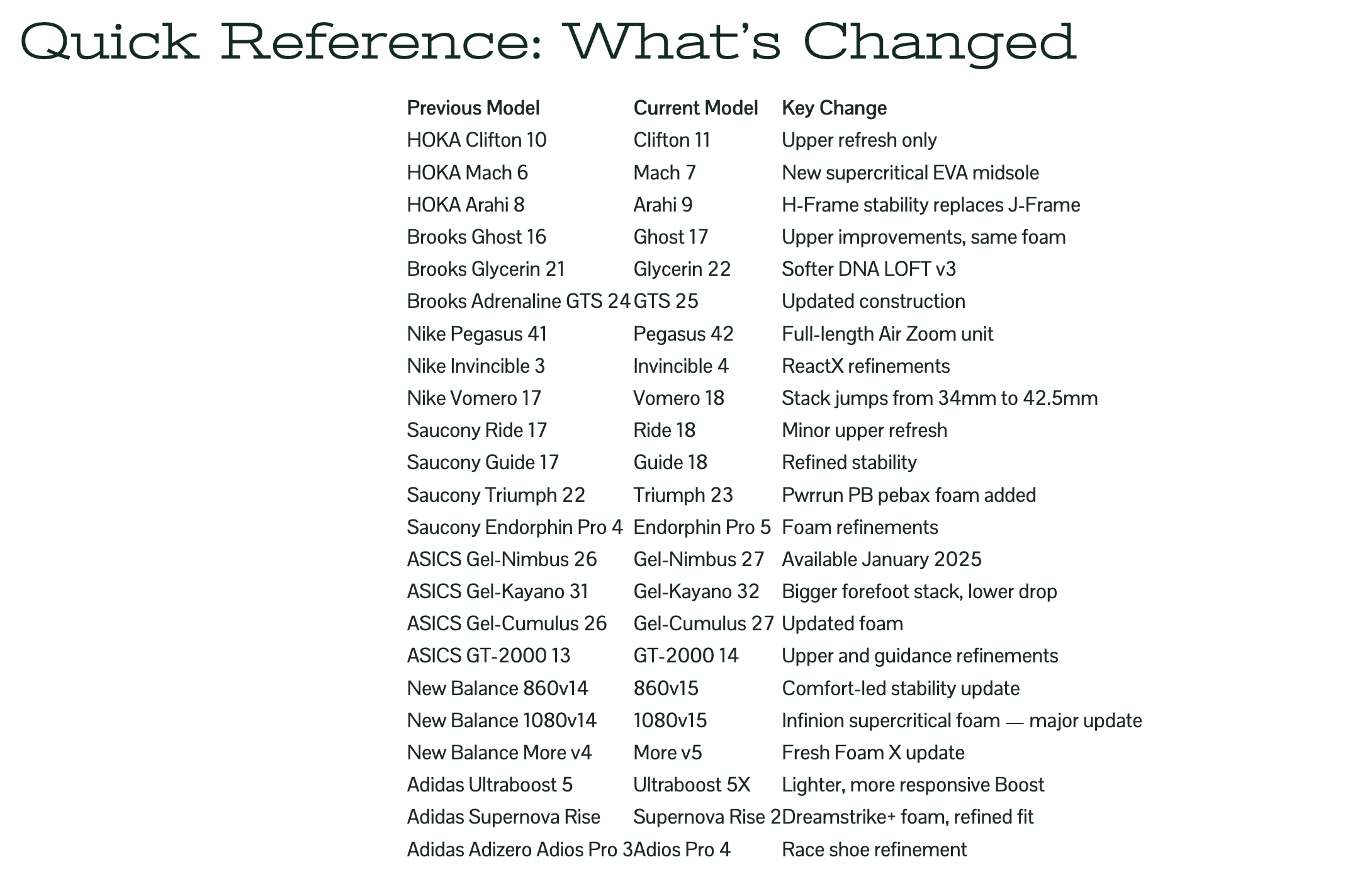
Quick Reference: What’s Changed
| Previous Model | Current Model | Key Change |
|---|---|---|
| HOKA Clifton 10 | Clifton 11 | Upper refresh only |
| HOKA Mach 6 | Mach 7 | New supercritical EVA midsole |
| HOKA Arahi 8 | Arahi 9 | H-Frame stability replaces J-Frame |
| Brooks Ghost 16 | Ghost 17 | Upper improvements, same foam |
| Brooks Glycerin 21 | Glycerin 22 | Softer DNA LOFT v3 |
| Brooks Adrenaline GTS 24 | GTS 25 | Updated construction |
| Nike Pegasus 41 | Pegasus 42 | Full-length Air Zoom unit |
| Nike Invincible 3 | Invincible 4 | ReactX refinements |
| Nike Vomero 17 | Vomero 18 | Stack jumps from 34mm to 42.5mm |
| Saucony Ride 17 | Ride 18 | Minor upper refresh |
| Saucony Guide 17 | Guide 18 | Refined stability |
| Saucony Triumph 22 | Triumph 23 | Pwrrun PB pebax foam added |
| Saucony Endorphin Pro 4 | Endorphin Pro 5 | Foam refinements |
| ASICS Gel-Nimbus 26 | Gel-Nimbus 27 | Available January 2025 |
| ASICS Gel-Kayano 31 | Gel-Kayano 32 | Bigger forefoot stack, lower drop |
| ASICS Gel-Cumulus 26 | Gel-Cumulus 27 | Updated foam |
| ASICS GT-2000 13 | GT-2000 14 | Upper and guidance refinements |
| New Balance 860v14 | 860v15 | Comfort-led stability update |
| New Balance 1080v14 | 1080v15 | Infinion supercritical foam — major update |
| New Balance More v4 | More v5 | Fresh Foam X update |
| Adidas Ultraboost 5 | Ultraboost 5X | Lighter, more responsive Boost |
| Adidas Supernova Rise | Supernova Rise 2 | Dreamstrike+ foam, refined fit |
| Adidas Adizero Adios Pro 3 | Adios Pro 4 | Race shoe refinement |
Physio Bottom Line
For most injury-return runners, the meaningful updates in 2025/26 are:
Saucony Triumph 23 — pebax foam in a daily trainer is a genuine step forward for high-mileage protection without plate stress.
New Balance 1080v15 — Infinion foam is a noticeable improvement; the best max-cushion/wide-fit combination in the market right now.
HOKA Arahi 9 — H-Frame technology makes this a more biomechanically complete stability shoe than its predecessors.
Nike Vomero 18 — the jump to 42.5mm stack is significant; now competes directly with Bondi and 1080 for maximum protection.
If you want help choosing the right shoe for your foot type, injury history, and training load, use the Shoe Finder in the PhysioRun app — it matches you to specific models based on your profile.
James · PhysioRun · physiorun.net
All stack heights sourced from manufacturer data and independent lab measurements. Prices correct at time of writing.
Comments are closed